In-situ testing represents a cornerstone of geotechnical engineering in Knoxville, encompassing all field-based methods used to evaluate soil, rock, and groundwater conditions directly in their natural state. Unlike laboratory tests that rely on disturbed samples, in-situ techniques preserve the inherent structure, stress history, and moisture regime of subsurface materials. This category covers a broad spectrum of procedures—from strength and deformation assessments to permeability and density measurements—each tailored to capture critical design parameters without the uncertainties introduced by sampling and transport. For a city experiencing steady infrastructure growth along the Tennessee River corridor, the reliability of these field measurements directly influences foundation design, slope stability analysis, and earthwork quality assurance.
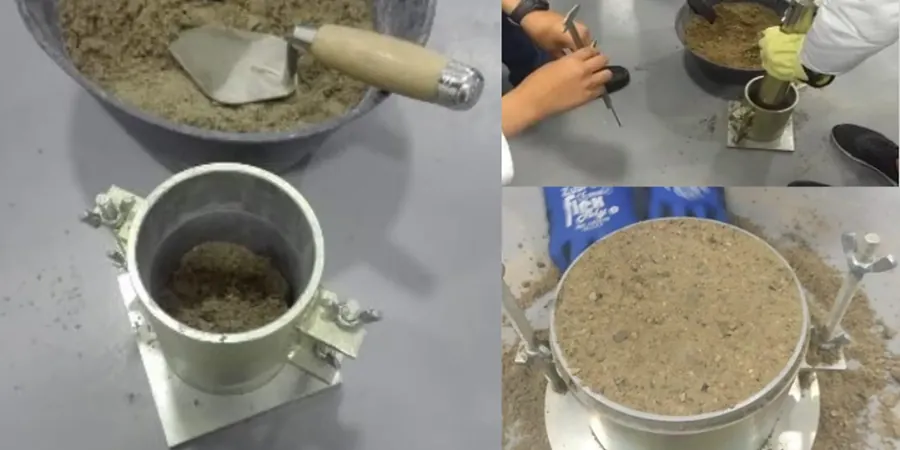
Knoxville's geology presents a challenging and varied profile that makes rigorous in-situ investigation essential. The region lies within the Valley and Ridge physiographic province, characterized by folded and faulted sedimentary rocks—primarily limestone, dolomite, and shale of the Knox Group—overlain by residual soils and alluvial deposits in the river valleys. These residual soils, derived from in-place weathering of carbonate bedrock, often exhibit highly variable consistency and may contain solution features, pinnacled rock, or clay-filled cavities. Alluvial terraces along the Tennessee and Holston Rivers introduce layers of soft, compressible silts and clays that demand careful field characterization. In such conditions, a field density test (sand cone method) becomes invaluable for verifying compaction in the variable near-surface soils common to Knoxville construction sites.
Practitioners working in Knoxville must adhere to nationally recognized standards, primarily those established by ASTM International, which are referenced by local building codes and regulatory agencies. ASTM D1586 governs the Standard Penetration Test (SPT), the most widely used in-situ method for soil strength profiling. For density verification, ASTM D1556 outlines the sand cone method, while ASTM D6938 covers nuclear gauge alternatives. Cone Penetration Testing (CPT) follows ASTM D5778, offering continuous stratigraphic profiling particularly useful in the alluvial deposits flanking the Tennessee River. The Tennessee Department of Environment and Conservation (TDEC) and local stormwater regulations further require in-situ infiltration testing per ASTM D3385 or D5093 for stormwater management design. These standards ensure that data collected across different contractors and projects remains consistent, defensible, and suitable for design.
The types of projects in Knoxville that demand comprehensive in-situ investigations span the full spectrum of civil construction. Commercial developments in the Turkey Creek area and downtown high-rises rely on SPT and CPT data to size deep foundations penetrating through residual soils into competent rock. Transportation infrastructure—including I-40/I-75 interchange improvements and Knoxville Area Transit expansions—requires rigorous subgrade evaluation and compaction control. Residential subdivisions in the growing Hardin Valley and Powell corridors need percolation testing for septic system design and density verification for engineered fills. Even smaller-scale retaining walls and slope stabilization projects benefit from field vane shear testing or pressuremeter tests to define in-situ strength parameters accurately.
In-situ testing evaluates soil and rock properties directly in the ground without removing samples, preserving natural stress states, moisture content, and fabric. Laboratory testing uses disturbed or undisturbed samples extracted from boreholes. While lab tests allow controlled conditions and specific parameter determination, in-situ methods avoid sample disturbance and deliver continuous profiles, making them complementary approaches where field tests often better represent mass behavior.
The Standard Penetration Test (SPT) remains the most common method for profiling residual soils in Knoxville, providing both soil samples and blow count data. Cone Penetration Testing (CPT) is increasingly used in alluvial deposits along the Tennessee River. For compaction verification in residual clayey soils, the sand cone method per ASTM D1556 is standard, while pressuremeter tests help characterize the variable stiffness of weathered Knox Group materials.
The City of Knoxville adopts the International Building Code (IBC), which references ASTM standards for geotechnical investigations. Chapter 18 of the IBC requires soil investigations for all structures, specifying minimum borehole depths and in-situ test frequencies. Additionally, TDEC stormwater regulations mandate in-situ infiltration testing for post-construction runoff management. Local amendments may require specific reporting formats and licensed geotechnical engineer oversight for test execution.
In karst terrain underlain by carbonate bedrock, in-situ tests may encounter highly variable conditions over short distances due to solution features, pinnacled rock, and clay-filled voids. SPT refusal can occur abruptly on rock pinnacles while adjacent areas show deep soil. CPT may be impractical in very dense gravelly residual soils. These limitations require experienced interpretation, often supplemented by geophysical surveys or probe drilling to map erratic bedrock topography accurately.