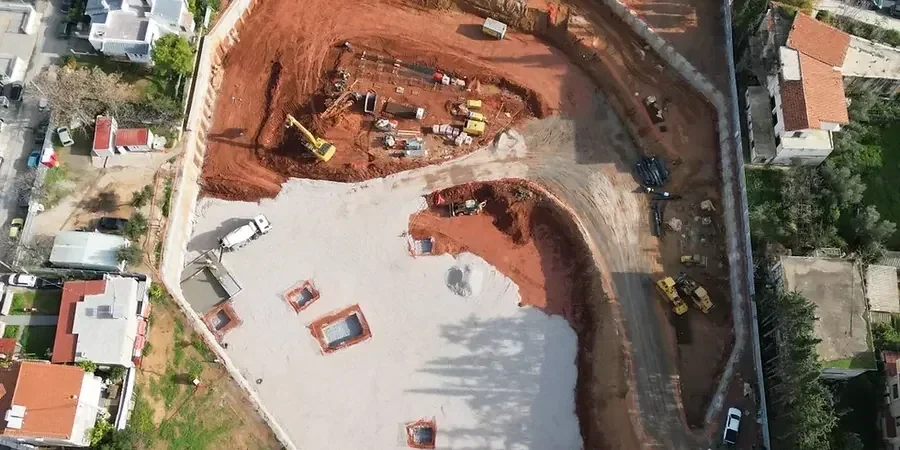
Excavating twenty feet near the Tennessee River on Neyland Drive presents a completely different set of rules than cutting into weathered shale up in the Bearden area. Downtown Knoxville sits on a complex transition between the Holston formation limestone and the Rome formation shales, which means you can encounter pinnacled rock in one corner of the site and stiff residual clay in the other. The geotechnical design of deep excavations here cannot rely on textbook assumptions; it requires a detailed site characterization that accounts for solution cavities, variable groundwater perched within the epikarst, and the seismic demands of ASCE 7-22. We integrate borehole data from spt-drilling to calibrate strength parameters and map the rock surface, ensuring the shoring system is designed for the real ground conditions, not an idealized profile.
In Knoxville's karst terrain, the critical failure mode for a deep excavation is rarely a simple base heave — it is the sudden loss of ground into a previously undetected solution cavity beneath the cut.
Process overview
A typical deep excavation support system for a Knoxville parking garage or mixed-use building starts with the drilling rig. For a soldier beam and lagging wall through dolomitic limestone with scattered chert nodules, we specify a track-mounted hydraulic drill with down-the-hole hammer capability, capable of penetrating rock sockets to depths of 15 feet or more below subgrade. The design sequence follows the observational method outlined in FHWA GEC No. 2: we establish pre-excavation inclinometer baselines, then monitor horizontal deflections at each lift. Tieback anchors are designed with unbonded lengths extending well beyond the active wedge, typically 10 to 15 feet into competent limestone with a minimum unconfined compressive strength of 7,500 psi, verified through laboratory testing of rock core. Dewatering becomes critical where the weathered rock zone transmits water through interconnected fissures; we often combine deep wells with vacuum-assisted sumps to maintain a dry excavation bottom, especially during the wet winter months when the water table can rise three to four feet above its summer low.
Local context
Knox County sits within Seismic Zone 2 per the USGS National Seismic Hazard Model, with a 2,475-year spectral acceleration of approximately 0.25g at short periods on rock. The deeper concern for the geotechnical design of deep excavations is not just the acceleration itself but the behavior of the residual clay derived from limestone weathering. This material can lose significant shear strength under cyclic loading, pushing the factor of safety for a temporary shoring wall below the 1.25 minimum required by OSHA Subpart P if not accounted for in the drained friction angle. Karst voids amplify the risk further: a small cavity roof collapse during excavation can propagate upward, creating a sinkhole that destabilizes the entire support system. Our approach includes pre-excavation electrical resistivity tomography along the alignment to screen for anomalies larger than three feet in diameter, followed by probe drilling at suspect locations before soldier beam installation begins.
Common questions
What is the typical cost range for geotechnical design of a deep excavation in Knoxville?
The engineering design fee for a deep excavation in the Knoxville area typically ranges from US$2,370 to US$9,480, depending on the excavation depth, complexity of the shoring system, and extent of pre-design subsurface investigation required. A straightforward soldier beam wall for a 20-foot cut with one tieback level falls at the lower end, while a 35-foot excavation with multiple anchor rows, karst probing, and instrumentation plans moves toward the upper bound.
How do you handle the risk of sinkholes during excavation in Knoxville's karst terrain?
We screen the excavation footprint with electrical resistivity tomography (ERT) and microgravity surveys before mobilization. Any anomaly larger than three feet in diameter is investigated with a probe drill. If a cavity is confirmed, we either relocate the shoring elements to span it, or grout the void using a low-mobility fill mix designed to prevent hydraulic fracture of the surrounding rock.
What seismic requirements apply to temporary shoring walls in Tennessee?
Temporary excavation support systems in Knoxville must still meet the seismic design parameters of ASCE 7-22 and the IBC, even though they are not permanent structures. A pseudo-static analysis with a horizontal acceleration coefficient of 0.10g to 0.15g is typical for temporary walls, unless the project is classified as Risk Category IV, where higher coefficients apply.