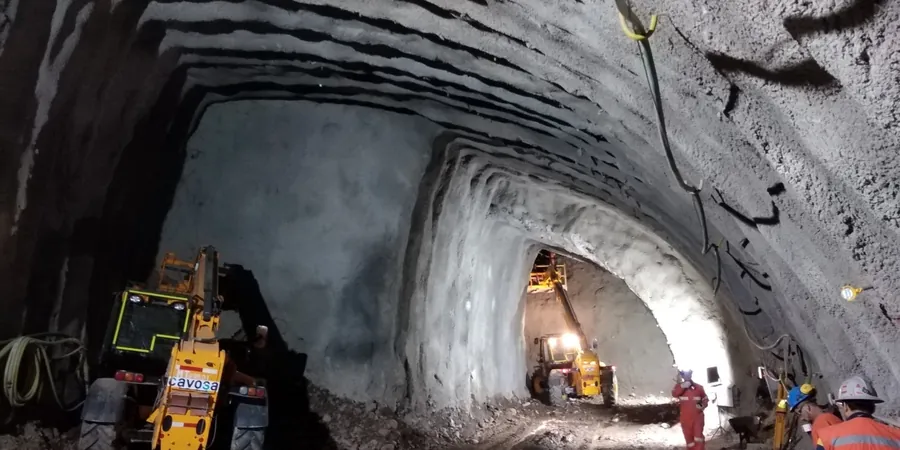
Knoxville sits on a complex mix of residual soils over limestone and dolomite, with thick valley fill along the Tennessee River and its tributaries. When a tunnel alignment hits saturated clay seams or loose alluvium at depth, the margin for error disappears fast. We see too many feasibility studies that rely on regional maps instead of site-specific data, and that leads to nasty surprises at the cutterhead. A proper soft-ground-tunnels analysis here has to account for the rapid transition from stiff saprolite to soft, compressible layers within a few hundred feet. Our lab runs every sample under ASTM D2487 to classify the fine-grained material before modeling begins.
In Knoxville’s valley geology, the difference between a stable tunnel and a settlement claim often comes down to one extra Shelby tube sample in a suspect silt layer.
Common questions
What soft soil conditions are typical for Knoxville tunnels?
The Tennessee River valley and its tributary creeks deposit thick sequences of alluvial clay and silt over karstic limestone. We frequently encounter CL and CH materials with SPT N-values between 2 and 8, undrained shear strengths from 500 to 1500 psf, and occasional organic lenses near old river channels. The transition from residual soil to fresh rock can be abrupt, which complicates mixed-face tunneling.
How long does a soft soil tunnel investigation take?
A typical program with 4-6 boreholes, CPT soundings, and full laboratory testing runs 4 to 6 weeks from mobilization to final report. We accelerate the schedule when the contractor needs early data for TBM procurement. Rush turnaround on critical samples is available.
What does a tunnel geotechnical analysis cost in Knoxville?
Budget between US$3,720 for a limited investigation with two boreholes and basic lab testing, up to US$17,450 for a comprehensive program including CPT, triaxial testing, and full GBR preparation. The final scope depends on tunnel length, depth, and proximity to sensitive structures.
Do you handle mixed-face conditions where soft soil meets rock?
Yes. Mixed-face tunneling through decomposed rock and overlying soft clay is common in Knoxville. We characterize both materials in the same borehole, run unconfined compression on the rock core, and deliver face percentage maps so the TBM operator can adjust cutterhead torque and conditioning foam dosage zone by zone.