← Home · Slopes & Walls

Retaining Wall Design in Knoxville: Geotechnical Parameters & Compliance

Together, we solve the challenges of tomorrow.

SEE MORE →

The shift from the dolomite bedrock of South Knoxville to the deep saprolitic clays north of the Tennessee River creates sharply different lateral earth pressures within a single project. A cantilever wall keyed into the Mascot formation behaves nothing like one embedded in the weathered shale of the Bearden area, where seasonal moisture swings can double the active pressure. Our laboratory team runs consolidated-undrained triaxial tests on Shelby tube samples from each stratum to define the drained and undrained shear strength envelopes required for a rational retaining wall design. For walls exceeding six feet in height, the Knox County permitting office expects a slope stability analysis that accounts for the residual colluvium common on the valley slopes.

A retaining wall is only as good as the drainage aggregate behind it; a soil with 15% fines will clog the drains and double the lateral thrust in one rainy Knoxville winter.

Process overview

The hot, humid summers and freeze-thaw winter cycles of the Tennessee Valley impose a strict durability requirement on retaining wall design. Backfill behind a Mechanically Stabilized Earth (MSE) wall at the Turkey Creek commercial zone must remain free-draining through dozens of wet-dry cycles each year; we specify AASHTO No. 57 stone wrapped in a nonwoven geotextile and verify gradation compliance with ASTM D6913 before placement. For cast-in-place gravity walls near the Holston River floodplain, the design must check overturning and sliding under both the normal pool elevation and the rapid drawdown condition, using the effective stress parameters from our direct shear tests. The 2018 Smead landslide in the Sequoyah Hills area remains a case study in what happens when a retaining wall design ignores the pore pressure buildup in the underlying clay shale.
Retaining Wall Design in Knoxville: Geotechnical Parameters & Compliance
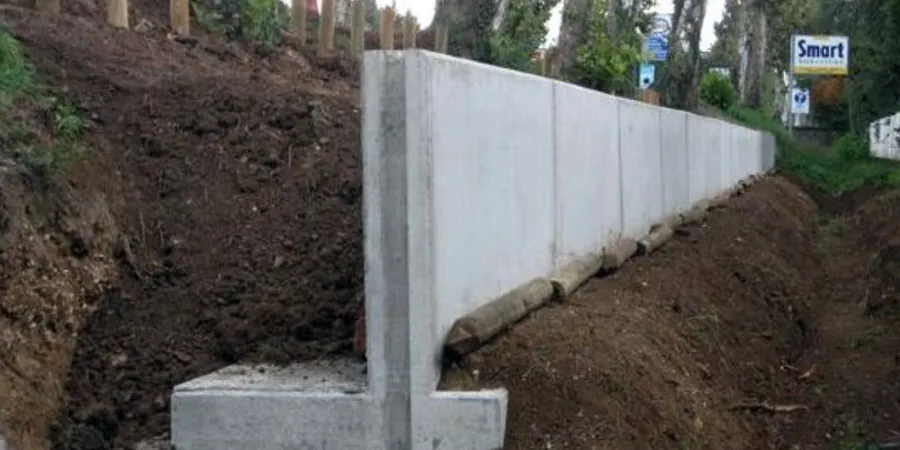
Technical reference image — Knoxville

Local context

IBC 2024 Section 1807.1.2 requires a geotechnical investigation for any retaining wall supporting more than four feet of unbalanced fill, and Knox County enforces this strictly after several failures in the Cedar Bluff area during the 2020 wet season. The dominant failure mode in East Tennessee is not bearing capacity but global instability: a wall founded on a sloping bench cut into the Chickamauga formation can fail along a deep-seated circular slip surface that daylight wells beyond the wall heel. Our report includes a Spencer method analysis using the peak and fully softened strength of the shale fill, because the slickensided surfaces in the local rock control the long-term factor of safety. Ignoring the hydrostatic pressure behind an undrained wall in a Knoxville winter, when the ground freezes at the surface but stays saturated at depth, is the quickest way to lose a wall.

Need a geotechnical assessment?

Reply within 24h.

Email: contact@geotechnicalengineering.biz

Technical parameters


ParameterTypical value
Design StandardIBC 2024 Section 1807, AASHTO LRFD 10th Ed. (MSE walls)
Seismic LoadASCE 7-22 Section 11.8.7, Mononobe-Okabe pseudo-static method
Bearing Capacity Safety Factor (Static)FS ≥ 3.0 for granular; FS ≥ 2.5 for cohesive residual soil
Sliding ResistanceFS ≥ 1.5 (static); FS ≥ 1.1 (seismic) per IBC 1807.2.3
Backfill Internal Friction34°-38° for washed stone (AASHTO No. 57), verified by direct shear
Global Stability Minimum FSFS ≥ 1.5 (long-term), FS ≥ 1.2 (seismic) per FHWA-NHI-05-043
Drainage RequirementWeep holes at 5 ft o.c., continuous gravel drain 12 in. wide, filter fabric per AASHTO M288

Additional services

01

Wall Type Selection & Preliminary Sizing

We evaluate the site topography, right-of-way constraints, and subsurface profile to recommend the most cost-effective system: a conventional cantilever wall for cuts under 10 ft in competent soil, an MSE wall with galvanized steel strips for fills behind a commercial building, or a soldier pile and lagging system for a tight urban excavation on Gay Street. Each option comes with a preliminary section showing stem thickness, heel length, and embedment depth based on the active and passive earth pressure coefficients derived from our lab tests.

02

Final Design Package & Construction Observation

Our sealed report delivers the external stability calculations (sliding, overturning, bearing capacity) and the global stability cross-section for the most critical wall profile. We specify the compaction standard for the reinforced fill (95% of ASTM D698 maximum dry density at ±2% of optimum moisture) and the drainage detail. During construction, our technician performs nuclear density testing on the backfill lifts and confirms that the weep holes are clear before the contractor places the next lift.

Reference standards


IBC 2024 Section 1807 – Retaining Walls, ASCE 7-22 Minimum Design Loads – Ch. 3 Lateral Earth Pressure, AASHTO LRFD Bridge Design Specifications, 10th Ed. – Section 11 Abutments and Walls, ASTM D4767 – Consolidated Undrained Triaxial Test (for effective stress parameters), ASTM D6913 – Particle Size Distribution (backfill compliance)

Common questions

Does Knox County require a geotechnical report for a segmental block wall under 6 feet tall?

IBC 2024 exempts walls under 4 feet from a geotechnical report, but Knox County amendments to Section 1807.1.2 require a sealed investigation for any wall retaining over 3 feet of fill if it is within 10 feet of a property line or public right-of-way. A 5-foot segmental block wall in a backyard off Kingston Pike would still need a boring log, a soil classification per ASTM D2487, and a letter from the geotechnical engineer confirming the bearing stratum and the drainage plan. The county plan reviewer will red-tag a permit application that lacks these documents.

How do you handle the seismic design of a retaining wall in Knoxville?

Knox County is in Seismic Design Category C per the ASCE 7-22 hazard maps, with a mapped Ss of 0.40g at the 2475-year return period. For a wall over 6 feet, we apply the Mononobe-Okabe pseudo-static method with a horizontal acceleration coefficient kh equal to half the peak ground acceleration. The active earth pressure coefficient Kae is computed using the backfill friction angle from our direct shear tests and the wall-backfill interface friction, typically 2/3 of the backfill friction for a cast-in-place concrete wall. The resulting seismic thrust is applied at 0.6H above the base, and the sliding and overturning checks must meet the reduced safety factors in IBC 1807.2.3.

What is the cost range for a geotechnical retaining wall design in Knoxville?

A complete retaining wall geotechnical package in Knoxville, including one standard penetration test boring to 25 feet, laboratory direct shear or triaxial testing on two samples, and the final sealed design report with global stability analysis, typically falls between US$1,020 and US$4,770. The variation depends on the wall height, the number of borings required, and whether we need to run a consolidation test on the foundation clay to estimate long-term settlement of the wall.

How do you test the backfill material before it goes behind the wall?

We run a sieve analysis (ASTM D6913) and an Atterberg limits test (ASTM D4318) on a representative sample of the proposed backfill to confirm it classifies as SW or GW with less than 5 percent passing the No. 200 sieve. For an MSE wall, the backfill must also meet the electrochemical requirements of AASHTO T-288 to prevent corrosion of the steel reinforcement. During placement, our field technician performs a nuclear density test (ASTM D6938) on every 12-inch lift to verify 95 percent compaction of the maximum dry density from a modified Proctor test, and we check the moisture content against the optimum range to prevent post-construction settlement behind the wall face.
Location and service area

We serve projects across Knoxville and its metropolitan area.

View larger map