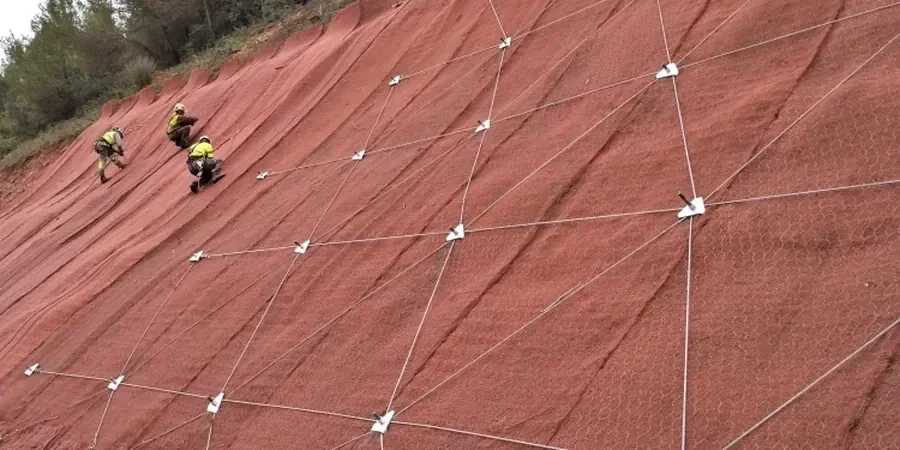
Knoxville sits at roughly 886 feet above sea level, where the Tennessee River cuts through a landscape of narrow ridges and steep hollows. That topography, combined with decades of residential expansion into hillside lots south of the river and along the Holston River bluffs, makes slope stability analysis a recurring necessity. Our lab team has evaluated dozens of cuts and fills across Knox County, from the karst-prone terrain near Bearden to the shale slopes in South Knoxville. When a developer or civil engineer calls us, the conversation usually starts with a specific problem: a tension crack behind a retaining wall, a fill that crept after heavy rain, or a planned cut that needs a reliable factor of safety before grading permits move forward. We approach each analysis by integrating site-specific subsurface data, in-situ permeability measurements where seepage is a concern, and the shear strength parameters we derive from our own triaxial and direct shear testing programs.
A slope that stands at 1H:1V in dry summer can fail at 2.5H:1V after a wet Knoxville spring if pore pressures build in the residual clay.
Local context
In Knoxville, many slope problems we see start with uncontrolled surface water, not deep geology. A homeowner builds a driveway across a natural drainage swale, or a contractor leaves a cut face exposed through winter. Even a well-compacted fill can unravel if the toe gets saturated and loses suction. We've inspected sites near Cherokee Bluffs where a 15-foot cut in saprolite stood for five years and then moved two inches in a single rain event, just because a blocked culvert concentrated runoff at the top. That's why our recommendations emphasize drainage controls—interceptor ditches, toe drains, and surface grading—alongside any structural solution. The risk isn't just the slope failing; it's the lag time. Progressive creep can go unnoticed until the factor of safety drops below 1.0, and by then the repair costs triple.
Reference standards
IBC 2021 (adopted by State of Tennessee, Knox County amendments) Section 1803 geotechnical investigations, FHWA-NHI-05-123 Soil Slope and Embankment Design manual, ASCE 7-22 Chapter 11 seismic design parameters for Knoxville, ASTM D4767-11 Standard Test Method for Consolidated Undrained Triaxial Compression Test for Cohesive Soils, ASTM D4318-17 Standard Test Methods for Liquid Limit, Plastic Limit, and Plasticity Index of Soils, Tennessee Department of Environment & Conservation (TDEC) stormwater and erosion control guidelines
Common questions
What triggers a slope stability analysis requirement in Knoxville?
Knox County grading permits typically require a geotechnical report with slope stability analysis for any cut or fill steeper than 2H:1V and taller than 10 feet, or when the slope is within 50 feet of a structure or public right-of-way. The IBC 2021 Section 1803 also triggers investigation when site conditions indicate potential instability, such as existing landslide deposits, expansive clay seams, or slopes exceeding 20 degrees in colluvial soils. Our lab coordinates with the reviewing geotechnical engineer to scope the analysis per county requirements.
How much does a slope stability analysis cost in Knoxville?
A complete slope stability analysis with field investigation, laboratory shear strength testing, and limit-equilibrium modeling generally ranges from US$1,250 to US$4,820. The spread depends on the number of cross-sections analyzed, whether we need triaxial testing or can use direct shear, and the complexity of the groundwater monitoring. A single-lot residential slope with one critical section and index testing falls at the lower end. A multi-bench commercial cut with seasonal piezometer data and multiple failure modes runs at the upper end.
What is the difference between drained and undrained slope analysis?
Drained analysis uses effective stress parameters (c' and φ') and models the slope's behavior under long-term, steady-state seepage conditions. Undrained analysis uses total stress parameters and is critical for evaluating short-term stability during or immediately after construction, when pore pressures from loading have not yet dissipated. In Knoxville's residual clays, the undrained strength often controls temporary cut stability, while drained conditions govern permanent slopes. We run both scenarios and report the governing case.
How do you account for seismic loading in Knoxville slope designs?
We apply the pseudostatic method using horizontal seismic coefficients derived from the ASCE 7 Hazard Tool for Knox County site class C or D. For critical slopes, we run stability analyses with a horizontal coefficient between 0.07g and 0.15g depending on the design earthquake and acceptable deformation. If the pseudostatic factor of safety drops below 1.1, we may recommend a Newmark sliding block analysis to estimate permanent displacement and confirm it remains within tolerable limits for the structure served.