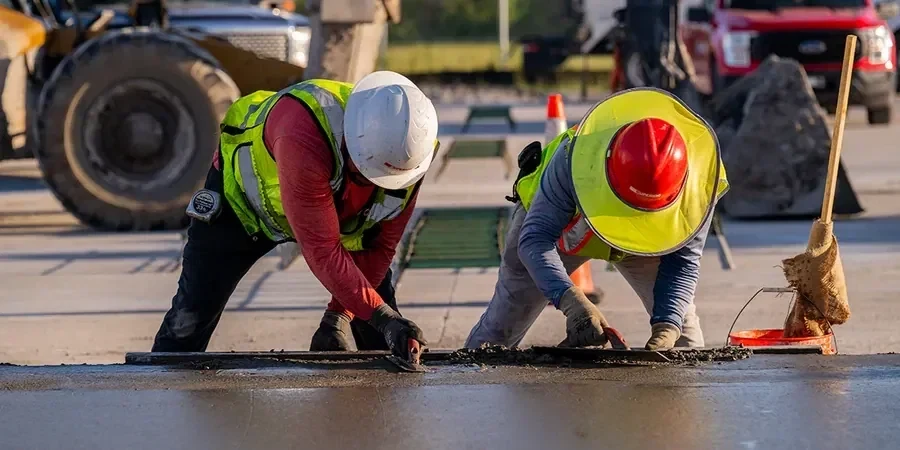
Drive across Knoxville long enough and you will notice some concrete pavements hold up for decades while others crack within a few freeze-thaw cycles. The difference is rarely the concrete mix alone. It starts underground. Many parts of the city sit on residual clays derived from weathered dolomite and limestone — material that swells when wet and shrinks during dry Tennessee summers. A rigid pavement design that ignores that behavior is doomed before the first truck rolls over it. We combine laboratory testing of subgrade soils with structural analysis of jointed plain concrete pavement (JPCP) sections to deliver a design that works with Knoxville’s geology, not against it. For projects near the Holston River or in the Fort Sanders area where fill soils are common, we often coordinate early with test pits to verify what is actually below the surface before finalizing the pavement cross-section.
A rigid pavement in Knoxville’s residual clay belt without a proper subgrade treatment is a liability, not an asset — the slab thickness means nothing if the soil beneath it is moving.
Process overview
Comparing two Knoxville job sites tells the whole story. A warehouse off Middlebrook Pike in West Knoxville sits on stiff, cherry-red residual clay — decent bearing capacity but high shrink-swell potential. A few miles east near Magnolia Avenue, the subgrade transitions to alluvial silts along First Creek, with much lower strength and a water table that rises after heavy rain. The same pavement design would fail in one of those locations. Good rigid pavement design treats each site separately. We evaluate the modulus of subgrade reaction (k-value) through plate load tests or back-calculation from CBR values measured in our accredited lab. Then we specify slab thickness, joint spacing, dowel diameter, and base course requirements following AASHTO 93 and TDOT Standard Specifications. The concrete mix design considers aggregate reactivity with alkalis, given that local quarries in the Knoxville area supply carbonate aggregates that can trigger alkali-silica reaction if the cement chemistry is not controlled.
Common questions
How much does a rigid pavement design for a commercial lot in Knoxville typically cost?
For a stand-alone commercial lot or small industrial yard in the Knoxville area, a complete rigid pavement design package — including subgrade testing, k-value determination, and slab/joint design — generally ranges from US$2,160 to US$5,430 depending on the number of borings or test pits and the complexity of the loading conditions.
Do we need to treat the red clay subgrade before placing a concrete pavement?
Almost always. Knoxville’s residual clays are moisture-sensitive. Lime stabilization or a thicker aggregate base can mitigate shrink-swell movement. The treatment method depends on the plasticity index from Atterberg limits testing — clays with PI above 25 typically require chemical modification to prevent long-term slab cracking.
What joint spacing works best for concrete pavements in this climate?
For JPCP sections in East Tennessee, we typically specify transverse joint spacing at 24 times the slab thickness — around 12 to 15 feet for a 6- to 8-inch slab. Tighter spacing reduces thermal curling stresses during Knoxville’s summer heat, but increases the number of joints to maintain. The final spacing is a balance between slab thickness, concrete modulus of rupture, and expected temperature gradient.
Can you design a rigid pavement over a known karst area near Knoxville?
Yes, but with additional precautions. We recommend a geophysical survey first to identify any shallow voids or solution features. The design may include a thicker, reinforced slab with closer joint spacing to bridge small voids, or a geogrid-reinforced base to deliver redundancy. In high-risk zones, we coordinate with a karst geologist to map the bedrock surface before finalizing the pavement cross-section.