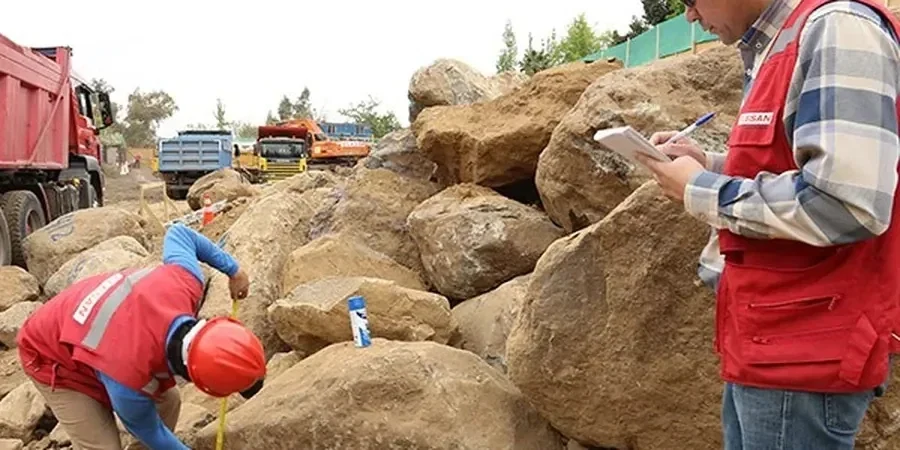
Knoxville sits at roughly 886 feet above sea level, straddling the Tennessee River and underlain by a complex karst landscape that keeps every geotechnical engineer on their toes. The city's population has pushed past 190,000, driving steady demand for new construction and renovation across neighborhoods like Sequoyah Hills and South Knoxville. The real challenge in Knoxville isn't just the clay; it's the network of dolomite and limestone bedrock that has weathered into a variable blanket of residual soil, often hiding solution cavities and pinnacled rock. A thorough soil mechanics study in Knoxville has to go beyond standard bearing capacity checks. We routinely integrate the CPT test to map the erratic bedrock profile with continuous data, and our team looks closely at the red clay's shrink-swell behavior because the moisture swings between Oak Ridge and Downtown can be brutal on lightly-loaded slabs. The University of Tennessee campus area, with its mix of old fill and natural colluvium, is a classic example where a soil mechanics study saves a project from costly surprises long before the first footing is poured.
In Knoxville's karst terrain, the biggest risk isn't always the clay you're building on — it's the void you might be building over.
Local context
ASCE 7-22 and the 2018 International Building Code set the baseline for site investigations in Knoxville, but the real driver for a detailed soil mechanics study is the karst hazard. The Tennessee Department of Environment and Conservation has mapped sinkhole-prone areas across Knox County, and we've seen enough dropouts on sites near Alcoa Highway to know that a standard grid of borings can miss a 10-foot-wide cavity by a few feet. The biggest structural threat comes from differential settlement where a footing bridges between competent rock and residual soil, creating a hinge point that cracks walls within the first two years. During a soil mechanics study in Knoxville, we push for deeper probes and, when the rock profile is erratic, we lean on the grouting works to stabilize the overburden or fill voids before they become a litigation problem. Ignoring the subsurface variability here isn't just a technical oversight; it's a financial gamble with a stacked deck against the owner.
Common questions
How deep do borings go for a soil mechanics study in Knoxville's karst area?
It depends on the structure and the site geology. For a typical commercial building near Downtown, we often extend borings to at least 10 feet into competent rock or until we've proven there are no voids beneath the bearing stratum. We use rock coring and air-track drilling to confirm the quality of the limestone. A shallow boring that stops at refusal might hit a floating boulder, not the true bedrock surface, which is why we insist on penetrating deeper in suspected karst zones.
What does a soil mechanics study cost for a residential lot in Knoxville?
For a standard residential parcel with a couple of borings, lab testing, and a report, the cost typically falls between US$3,020 and US$5,790. The final number depends on access for the drill rig, the depth to rock, and how many lab tests we run. If the site is on a steep slope in South Knoxville or requires specialized karst probing, the scope and price adjust accordingly.
Can I build on a lot with known sinkholes if I do a soil mechanics study?
Often yes, but you need a careful plan. A soil mechanics study identifies the extent of the cavity or soft zone and tells us whether it's active or stable. From there, we might recommend excavating and backfilling the feature with engineered fill, using a reinforced mat foundation, or injecting low-mobility grout to plug the void. The study gives you the data to design the right fix, rather than guessing and hoping for the best.
How long does a soil mechanics study take from start to final report?
Fieldwork in Knoxville usually takes one to three days for a standard site, depending on the number of borings and the difficulty of drilling through chert or pinnacled rock. Lab testing runs about two to three weeks for the full suite of consolidation and strength tests. We typically deliver the final geotechnical report within four weeks of the field work, faster if the project timeline is tight and we stage the lab testing.