Together, we solve the challenges of tomorrow.
SEE MORE →Geotechnical laboratory testing forms the analytical backbone of every well-executed construction and infrastructure project in Knoxville. This category encompasses the physical and mechanical evaluation of soil and rock specimens retrieved from subsurface explorations. From foundation design and slope stability analysis to environmental assessments and pavement engineering, laboratory data deliver the quantitative basis for safe, economical, and code-compliant designs. Without rigorous lab work, engineers are left relying on assumptions that can lead to costly failures in the region's variable ground conditions.
Knoxville's geology is dominated by the Valley and Ridge physiographic province, characterized by folded and faulted sedimentary rocks—primarily limestone, dolomite, and shale—overlain by residual and alluvial soils. These soils often exhibit significant spatial variability due to differential weathering of the underlying bedrock. Red clay residuum derived from limestone is widespread, while alluvial deposits along the Tennessee River and its tributaries introduce layers of silt, sand, and gravel. This geological complexity makes laboratory testing indispensable for understanding how local soils will behave under load, during wet-dry cycles, or when subjected to vibration.
In the United States, geotechnical laboratory procedures are governed primarily by ASTM International standards, which are adopted by reference in the International Building Code (IBC) and the Tennessee Department of Transportation (TDOT) specifications. Key ASTM methods include D422 for particle-size analysis, D4318 for Atterberg limits, D698 and D1557 for compaction characteristics, and D2435 for consolidation testing. TDOT Standard Specifications for Road and Bridge Construction further mandate specific testing frequencies and acceptance criteria for earthwork and aggregate materials, ensuring that public infrastructure projects across Knox County meet uniform performance benchmarks.
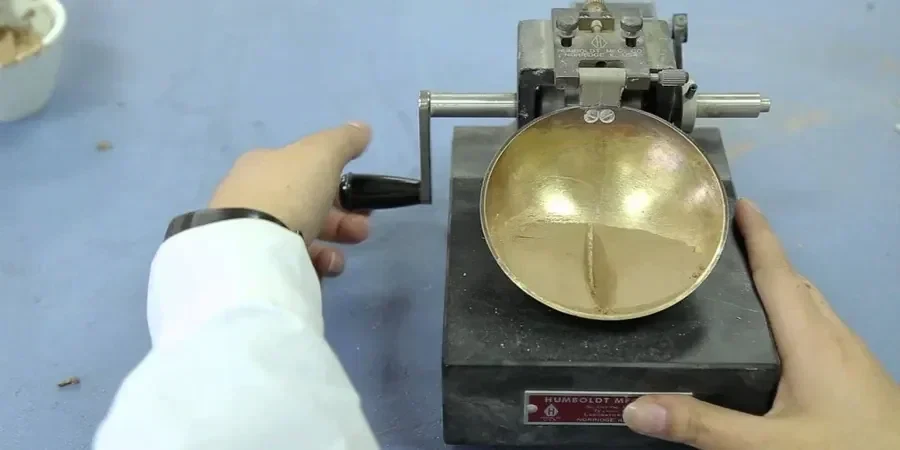
Projects that routinely demand comprehensive laboratory programs include commercial building excavations, residential subdivision grading, bridge abutment construction, and stormwater management facilities. A precise grain size analysis (sieve + hydrometer) is critical for classifying soils per the Unified Soil Classification System and predicting drainage behavior. Equally vital, Atterberg limits testing determines the moisture contents at which fine-grained soils transition between liquid, plastic, and semisolid states, directly informing foundation recommendations and shrink-swell potential assessments. These tests, along with strength and consolidation evaluations, form the core of any defensible geotechnical report.
Turnaround depends on the project scope and test types. Routine classification tests like grain size and Atterberg limits can be completed within five to seven business days. Consolidation, triaxial, or direct shear tests require longer curing and loading phases, often extending the schedule to two or three weeks. Expedited works are usually available for critical path decisions.
The most frequently referenced standards include ASTM D422 for particle-size analysis, D4318 for liquid limit, plastic limit, and plasticity index, D698 and D1557 for Proctor compaction, D2435 for one-dimensional consolidation, and D3080 for direct shear testing. TDOT specifications often mirror these methods while adding project-specific requirements for sampling frequency and material acceptance.
Atterberg limits testing quantifies the plasticity index, which is a primary indicator of shrink-swell potential. When combined with grain size distribution and natural moisture content, these results allow engineers to estimate volume change and prescribe mitigation measures such as moisture conditioning, chemical stabilization, or overexcavation and replacement with select fill.
Laboratories performing work on Tennessee Department of Transportation projects must hold current certifications through the AASHTO Accreditation Program (AAP) for the required test methods. Additionally, technicians should possess TDOT-approved qualifications, and the lab must participate in the AMRL proficiency sample program to demonstrate ongoing competence.