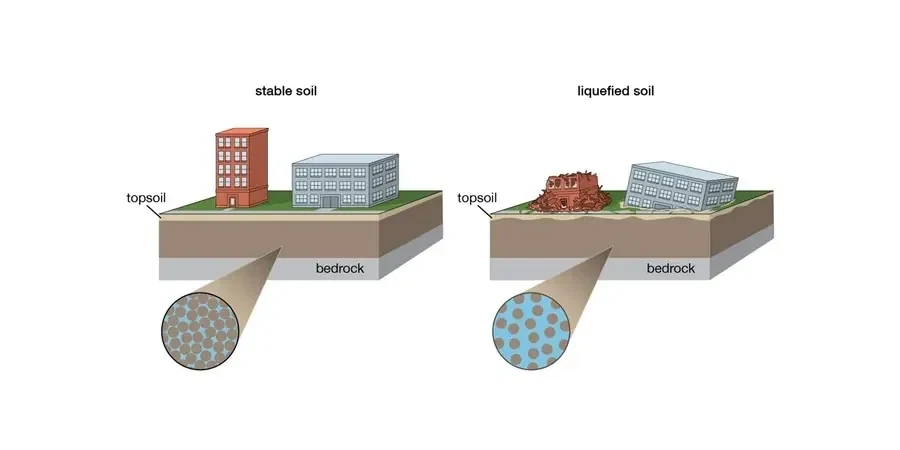
IBC Section 1803.5.12 requires liquefaction evaluation in Seismic Design Category D, E, or F when shallow groundwater is present. In Knoxville, that means any site within the Tennessee River and Holston River alluvial corridors gets flagged during plan review. The Tennessee River's floodplain deposits—loose sands and silts with water tables often within 6 feet—meet the classic criteria for flow liquefaction under the New Madrid Seismic Zone influence. Our lab runs the full SPT drilling sequence with split-spoon energy-corrected N-values, then applies the NCEER/Youd-Idriss (2001) simplified procedure to compute factor of safety against liquefaction. For sites where SPT refusal hits before 50 feet, we switch to CPT testing to get continuous tip resistance and sleeve friction profiles without losing data in the critical upper 30 meters.
Loose alluvium plus shallow groundwater equals mandatory liquefaction screening under IBC—no exceptions in Seismic Design Category D.
Reference standards
IBC Chapter 18 (Soils and Foundations), Section 1803.5.12, ASCE 7-22, Chapter 21 (Site-Specific Ground Motion Procedures), ASTM D1586-18 (Standard Test Method for SPT and Split-Barrel Sampling), ASTM D2487-17 (Classification of Soils for Engineering Purposes), NCEER/Youd-Idriss (2001) consensus paper on liquefaction evaluation
Common questions
Does Knoxville actually need liquefaction analysis? We are not on the West Coast.
Yes, IBC requires it. Knoxville is in Seismic Design Category D due to proximity to the East Tennessee Seismic Zone and the influence of the New Madrid Seismic Zone. Any site with loose saturated sands and groundwater within 50 feet of grade triggers the evaluation.
What does a liquefaction analysis cost in the Knoxville area?
For a typical commercial site with two SPT borings to 50 feet, laboratory grain-size and Atterberg testing, and the complete triggering and settlement report, the range is US$2,430 to US$4,800. The final number depends on boring depth, number of samples, and whether cyclic triaxial testing is specified.
How long does the field and lab work take before we get the report?
Field drilling usually takes one to two days. Laboratory grain-size and Atterberg tests require three to four working days. The engineering analysis and signed report are delivered within seven to ten working days from rig demobilization.
What if the SPT refusal is shallow and we cannot get deep enough data?
If SPT refusal hits above the liquefiable zone, we switch to CPT sounding (ASTM D5778) which can push through dense layers without losing stratigraphic resolution. The CPT tip resistance and friction ratio data integrate directly into the Robertson (2009) liquefaction triggering method as an alternative to SPT-based analysis.