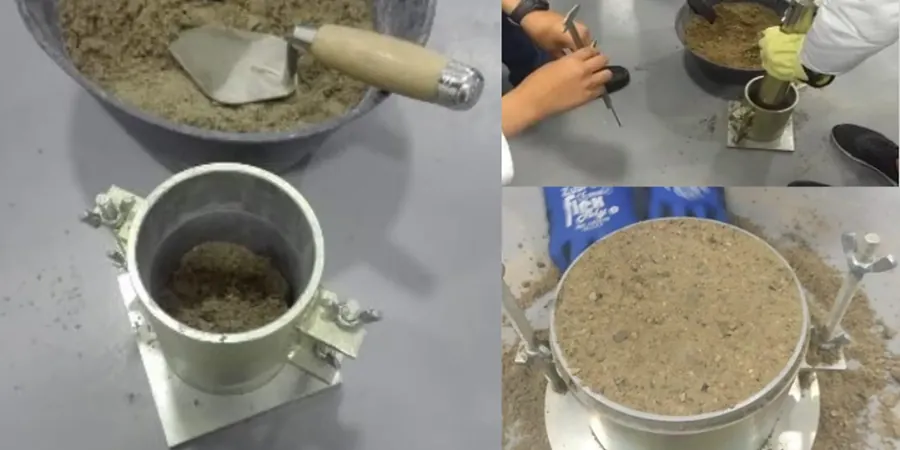
Knoxville sits in the Tennessee Valley, where residual clays, weathered shale, and silty chert residuum make moisture control the linchpin of every compaction spec. The wide swing from wet winters to dry late summers means a fill that passed in April can fail in August if the Proctor curve was never updated. That is exactly why the Proctor test, both Standard and Modified, is run on actual borrow material, not on a generic library curve. A single grain-size analysis run in parallel identifies the fines fraction that drives the optimum moisture content, because Knox County red clay does not compact like the gray shale from the ridges.
A one-percent shift in moisture off optimum can drop field density below 90 percent in Knoxville’s lean clays, and that is the difference between a passing lift and a rework.
Local context
The repeated mistake we see on Knoxville jobsites is running a Standard Proctor on fill that will later carry heavy compaction equipment or structural loads, and then blaming the grading contractor when densities come up short. Modified Proctor (56,000 ft-lbf/ft³) is the correct reference for engineered fill under footings, pavement subgrade, and MSE wall backfill in this region. Another persistent error is drying samples in an oven set above 60°C, which oxidizes the iron-rich East Tennessee clays and shifts the plasticity — the resulting Proctor curve no longer represents the material that goes under the sheepsfoot roller. When the sand cone density test shows a failing number, the root cause is often in the lab curve, not in the field.
Reference standards
ASTM D698-12 – Standard Test Methods for Laboratory Compaction Characteristics of Soil Using Standard Effort, ASTM D1557-12 – Standard Test Methods for Laboratory Compaction Characteristics of Soil Using Modified Effort, ASTM D2216 – Standard Test Methods for Laboratory Determination of Water (Moisture) Content of Soil and Rock by Mass, TDOT Standard Specifications for Road and Bridge Construction, Section 207, IBC Chapter 18 – Soils and Foundations (acceptance criteria for engineered fill)
Common questions
How much does a Proctor test cost in Knoxville?
A single-point or three-point Proctor compaction test in our Knoxville lab generally runs between US$90 and US$240, depending on whether you need the Standard effort (ASTM D698), the Modified effort (ASTM D1557), or both on the same material. The price covers sample preparation, the full moisture-density curve, and the lab report with the ZAV line plotted.
Which Proctor method — Standard or Modified — does TDOT require for roadway subgrade in Knox County?
TDOT Standard Specifications, Section 207, points to the Modified Proctor (ASTM D1557) for embankment and subgrade compaction on state-funded roadway projects. The Standard Proctor is occasionally accepted for low-height landscape fills, but any fill supporting pavement structure in the Knoxville area should be referenced to the Modified curve.
How long does it take to get results from a Proctor compaction test?
A routine turnaround is 24 to 48 hours once the sample arrives at the lab. If the material needs air-drying because it arrived saturated from a Knoxville rain event, we add a day to let the moisture come down without oven-drying the clay above 60°C, which would skew the plasticity and the resulting curve.
Why does the lab need a companion grain-size and Atterberg limits test with the Proctor?
The fines content and plasticity index directly control the shape of the moisture-density curve. Knoxville’s residual clays often plot with a flat, broad curve when the plasticity index is high, and the optimum moisture content can shift several points with a modest change in gradation. Without the index data, the field technician does not know how tight the moisture window really is.
Can I use the same Proctor curve for rock fill and soil fill on the same Knoxville site?
No. Rock fill, even weathered shale from the Chickamauga Group formations common around Knoxville, requires a separate Proctor on the finer fraction or a method specification. If the material has more than 30% retained on the 3/4-inch sieve, ASTM D698 and D1557 direct you to a correction procedure or to a different control method entirely, such as a test fill with performance-based acceptance.