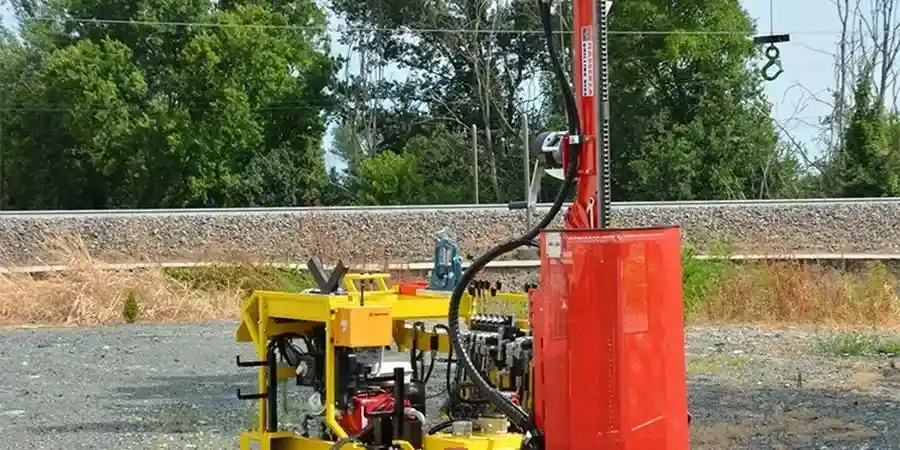
Knoxville sits at the edge of the Valley and Ridge province, where the humid subtropical climate weathers the underlying Knox Group dolomites into a thick mantle of residual silty clays. This creates a subsurface that shifts dramatically within a single lot—competent rock at five feet in one corner can drop to thirty feet of stiff saprolite in another. When we mobilize the SPT rig to a site near the Tennessee River or up toward Sharp’s Ridge, the first thing the drill crew watches for is the transition from the stiff overconsolidated crust into the deeper weathered zone, because that boundary controls both the blow count interpretation and the sampling recovery. A standard penetration test in this part of Knox County needs to be read with an eye on the regional geology, not just the hammer drop. For deeper profiling in the alluvial terraces along First Creek, we sometimes pair SPT borings with a CPT test to capture continuous tip resistance and pore pressure data where the standard split-spoon loses resolution in soft seams.
An SPT N-value without a USCS classification is just a number—Knoxville's residual soils demand both before you size a footing.
Local context
The CME-55 drill rig we run on Knoxville SPT jobs carries enough torque to push hollow-stem augers through the stiff residual clay crust without predrilling, which matters because predrilling through the desiccated zone can disturb the very material you need to sample intact. When the crew hits chert floaters—a constant hazard in the Knox Group residuum—the hammer energy can reflect back into the rod string and give a false refusal. Our drillers are trained to recognize that chatter, clean the hole, and retest rather than logging an inflated N-value. In the low-lying areas south of the river near the Holston confluence, we watch for groundwater artesian effects that reduce effective stress and can drop blow counts unexpectedly in the transition zone between alluvium and bedrock. Proper SPT execution in these conditions means controlling the energy delivered to the rod and documenting every deviation, because the geotechnical engineer reviewing the logs needs to know exactly what happened at depth.
Common questions
How much does an SPT boring cost in Knoxville?
Standard penetration test borings in the Knoxville area typically run between US$540 and US$780 per boring for depths up to 30 feet, depending on access, auger refusal depth, and the number of sampling intervals. Deeper borings, difficult access near slopes or creek banks, and projects requiring traffic control on city streets can push costs toward the upper end. The price includes the drill rig mobilization within Knox County, the split-spoon sampling at five-foot intervals, field logging, and the N₆₀ correction report.
How deep do SPT borings need to go for a residential foundation in Knox County?
For typical single-family residential construction on Knoxville's residual soils, SPT borings generally extend to 20 to 30 feet or until auger refusal on competent rock, whichever comes first. The IBC requires borings to penetrate through any questionable near-surface fill or soft alluvium and extend at least 10 feet into suitable bearing material. In the karst terrain of the Knox Group, we often encounter pinnacled rock at variable depths, so the boring depth is adjusted in the field based on real-time refusal and the structural load requirements.
What is the difference between an SPT boring and a soil test pit?
An SPT boring provides a continuous vertical profile with blow-count measurements at regular intervals and disturbed samples from depth, while a test pit allows direct visual inspection of the soil profile in a larger excavation but is limited to about 12 to 15 feet depth with standard equipment. SPT borings can reach 50 feet or more and give you N-values for bearing capacity calculations, whereas test pits are better for observing stratification, sampling undisturbed blocks, and checking utility conflicts near the surface. In Knoxville practice we often combine both—test pits for the near-surface characterization and SPT borings for deeper bearing evaluation.
Can SPT N-values be used to determine the seismic site class for a Knoxville building permit?
Yes. The IBC and ASCE 7-22 use the average SPT N-value (N₆₀) over the upper 100 feet of the soil profile to classify the site from Class A through F. In Knoxville, where residual soils often place sites in Class C or D, the SPT data must be corrected for overburden pressure and hammer energy, and the averaging procedure follows the standard N̄ calculation method in Chapter 20 of ASCE 7. The site class feeds directly into the seismic design coefficients used by the structural engineer for lateral force calculations.