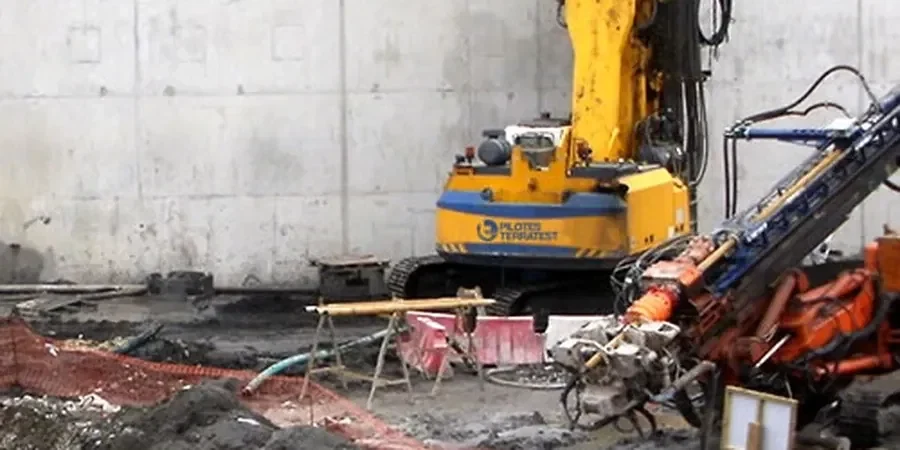
ASTM D5092 and the International Building Code (IBC) frame every grouting program we develop in Knoxville, where the irregular bedrock surface of the Knox Group dolomites and limestones creates a subsurface profile unlike any other in Tennessee. The city sits at roughly 900 feet elevation along the Tennessee River, underlain by folded and solution-weathered carbonate rock. That geology means sinkholes, pinnacled rock, and clay-filled cavities are routine finds at depths of 10 to 60 feet. A grouting design that ignores these features will bleed material into open voids or fail to consolidate the residual clay seams that separate competent limestone ledges. Our laboratory team runs permeability and grain-size tests on site-specific samples before selecting grout mix parameters, and we often pair the design with in-situ permeability testing when the formation is highly fractured. The goal is a treatment zone that bridges the transition from stiff residual soil to pinnacled rock, reducing hydraulic conductivity and increasing bearing uniformity beneath footings, slabs, or deep foundations across Knoxville.
Knoxville's pinnacled limestone demands a grouting design that treats the cavity, not just the overburden, or the improvement won't last through the first wet season.
Process overview
The contrast between a project in the Fort Sanders neighborhood and one out near West Hills illustrates why Knoxville grouting design cannot be copied from a generic specification. Fort Sanders sits on thin colluvium over limestone with frequent pinnacles, and water inflow during drilling is common. West Hills is underlain by deeper residual clay derived from the Chickamauga limestone, where permeability is lower but shrink-swell potential is significant. For the first case we favor a low-mobility compaction grout injected in stages to displace soft cavity fill without hydrofracturing the overburden. For the second, a permeation grout with microfine cement can fill desiccation cracks and reduce the clay's seasonal volume change. Our lab determines the cement-to-water ratio, bentonite content, and set time using Atterberg limits and particle-size distribution from the target stratum. Viscosity is measured with a Marsh funnel, and bleed is held below 2% for stable mixes. On larger commercial sites we specify verification via SPT refusal or cross-hole sonic logging after injection, giving the geotechnical engineer a direct before-and-after comparison of grout take and improvement.
Local context
The grout plant we mobilize for Knoxville jobs includes a colloidal mixer, a positive-displacement piston pump, and a digital flow meter that logs pressure, volume, and rate in real time. That data stream is non-negotiable because karst terrain here is unpredictable: a single borehole can swallow 200 gallons of grout in a cavity, then refuse injection two feet deeper on a limestone pinnacle. Without pressure-volume monitoring, the engineer cannot distinguish between a filled void and a hydraulic fracture propagating sideways through the clay. We've seen uncontrolled hydrofracturing lift floor slabs in downtown Knoxville when injection was pushed too fast. Our protocol sets a maximum pressure of 80% of the calculated overburden stress and a flow rate below 10 gallons per minute for cavity filling. The pump operator watches the pressure transducer on a dash-mounted display and cuts flow the moment the curve flattens, indicating refusal. That discipline prevents damage to adjacent utilities and keeps the grout where it belongs: in the target void.
Common questions
What does a grouting design package include for a Knoxville project?
The package includes a geotechnical data review, grout mix design with lab test results (bleed, viscosity, set time, unconfined compressive strength), injection parameters (pressure, flow rate, stage spacing), a QA/QC verification plan, and as-built documentation requirements. The design references ASTM D5092, IBC Chapter 18, and project-specific boring logs from the site.
How much does a grouting design typically cost in the Knoxville area?
For a typical commercial or residential project in Knoxville, the grouting design fee ranges from US$1,140 to US$3,910 depending on the number of treatment zones, the complexity of the karst conditions, and the laboratory testing program required to validate the mix.
How do you verify that the grouting actually improved the ground?
Verification relies on pre- and post-grouting SPT or CPT soundings, cross-hole sonic logging in soilcrete columns, and permeability testing in cutoff applications. The acceptance criteria are written into the design: a target N-value increase, a maximum hydraulic conductivity, or a minimum column diameter confirmed by core recovery.
Which grouting method works best in Knoxville's karst limestone?
Compaction grouting is the most common method for treating cavities and pinnacled rock in Knoxville because it displaces soft infill without excessive hydrofracturing. Where the goal is groundwater cutoff in fractured limestone, permeation grouting with microfine cement is more effective. The choice depends on the cavity size, depth to rock, and hydraulic conductivity measured in the exploratory borings.