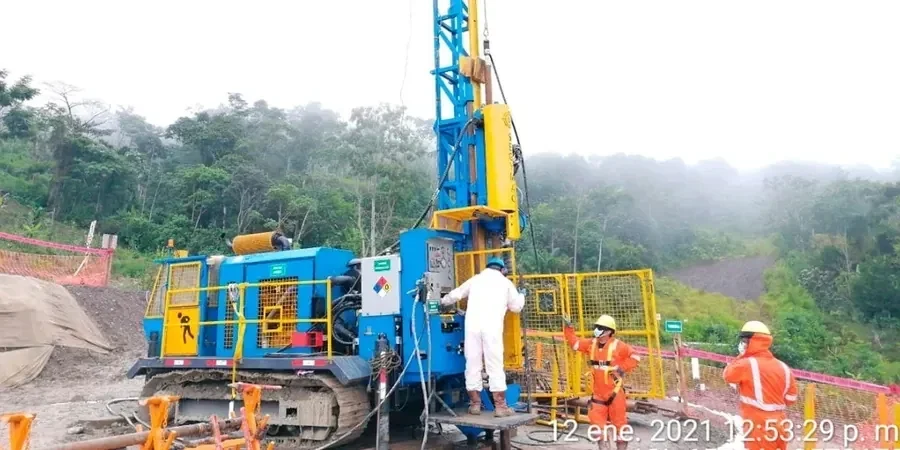
We have seen too many Knoxville projects where the geotech report had a nice lab permeability number but the site still flooded during a rainy spring. Lab tests on a 2-inch sample can't tell you what a fractured limestone seam or a loose colluvial layer will do at full scale. That is why the in-situ test matters. In a city that gets over 50 inches of rain a year and sits on a karst geology riddled with solution channels, guessing your groundwater flow is a costly gamble. A proper Lefranc or Lugeon test tells you exactly how water moves through the specific rock mass or soil layer you are dealing with — not a remolded specimen in a lab. For deeper rock sockets or dam cutoff evaluations, many engineers pair the Lugeon test with grouting design to define the curtain depth and injection pressures needed.
A Lugeon value doesn't just measure permeability — it quantifies the rock mass's need for grouting before excavation.
Local context
In Knoxville, we often see that contractors underestimate how fast water moves through the epikarst zone — that weathered, rubbly limestone right below the residual clay. You can hit a void or an open joint that connects straight to a nearby creek, and suddenly your dewatering plan is useless. The risk is not just a flooded excavation; it is groundwater lowering that triggers sinkhole collapse under an adjacent road or structure. A properly executed Lugeon test reveals the fracture conductivity and the critical pressure at which flow transitions from laminar to turbulent — the point where erosion of infill material begins. Without that data, you are designing a dewatering system blind, and the IBC's requirement for a safe excavation slope or shoring design becomes impossible to meet reliably on a karst site.
Common questions
What is the difference between a Lefranc test and a Lugeon test?
A Lefranc test measures permeability in soil or very weak rock using an open borehole section, either with constant or falling head. A Lugeon test uses inflatable packers to isolate a specific section of rock core hole and injects water under pressure — it is the standard for assessing fracture conductivity in bedrock.
How long does a field permeability test take on site?
A single Lefranc test in soil typically takes one to two hours. A Lugeon test with five pressure stages at one depth interval takes around two to three hours. The total time depends on how many intervals you need and the rock's response.
What does a Lugeon value actually mean?
One Lugeon unit equals roughly 1.3 × 10^-5 cm/s, and represents a water take of 1 liter per minute per meter of test section at 10 bars of pressure. Values below 1 suggest tight rock that probably does not need grouting; values above 10 indicate open fractures that will require treatment.
What does field permeability testing cost in the Knoxville area?
For budgeting, a Lefranc test program usually runs between $600 and $900, while a multi-stage Lugeon test in rock typically ranges from $800 to $1,190 per hole depending on depth and number of stages. The final figure depends on access, drilling setup, and how many intervals we test.