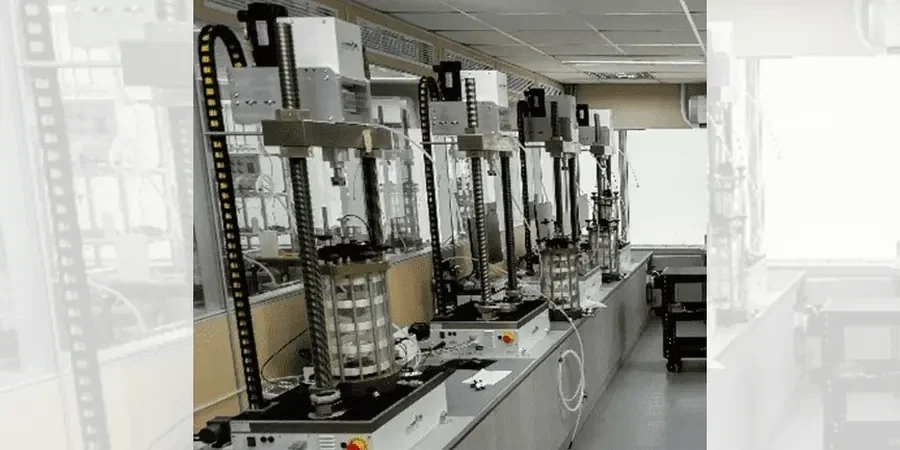
Knoxville sits along the Tennessee River, where the geology shifts dramatically between dolomite bedrock, residual clays from weathered limestone, and alluvial deposits in the valley floors. The depth to competent rock can vary from less than 10 feet to over 60 feet across a single site, a condition that directly influences how we approach sampling for advanced strength testing. When foundation loads must be transferred through these variable residual soils, a triaxial test becomes essential for determining the effective shear strength parameters that standard penetration resistance alone cannot deliver. The laboratory team works with Shelby tube samples extracted from specific horizons within the saprolite zone, ensuring that the confining pressures applied during testing reflect the actual overburden conditions at the project depth.
Effective stress parameters from triaxial testing reveal strength reductions that saturated conditions impose on Knoxville's residual clays, data no other laboratory method can quantify.
Local context
The IBC references ASTM D4767 as the standard for obtaining drained shear strength parameters used in foundation design, and this becomes particularly critical in Knoxville where the contact between residual soil and underlying karstic bedrock creates preferential seepage paths. Effective stress analysis using c′ and φ′ values from consolidated-undrained triaxial testing is the only reliable method for evaluating long-term stability of cut slopes in the Chickamauga limestone formation, where relic joints filled with low-plasticity silt can open during excavation and trigger block failures. Ignoring the influence of pore pressure on shear strength in these materials leads to unconservative factor-of-safety calculations. The laboratory accreditation under ISO 17025 ensures that every triaxial test report includes complete documentation of saturation, consolidation, and shear phases, allowing the design team to verify that specified acceptance criteria were met before parameters are used in final calculations.
Common questions
What does a triaxial test program for a Knoxville site typically cost?
A single consolidated-undrained triaxial test with pore pressure measurement on a cohesive soil specimen typically falls between US$2,140 and US$2,850, depending on the number of confining pressures specified and whether the project requires consolidated-drained testing with volume change measurement. Programs involving multiple specimens to define a complete Mohr-Coulomb envelope are priced on a per-specimen basis, with volume discounts available when the laboratory processes six or more specimens from the same boring.
When is a CU triaxial test required instead of a simpler unconfined compression test?
Unconfined compression provides only an undrained shear strength for saturated clays and cannot separate cohesion from friction. In Knoxville's residual silts and saprolitic soils, where effective stress parameters control long-term stability of slopes and foundations subject to fluctuating groundwater, the consolidated-undrained test with pore pressure measurement is the minimum standard. It yields both total and effective stress envelopes, data that unconfined compression cannot generate because no confining pressure is applied and no pore pressure is measured during shear.
How long does it take to receive triaxial test results after sampling?
A standard consolidated-undrained triaxial test requires between five and eight business days from specimen extrusion to final report delivery. The timeline is driven by the consolidation phase, which must continue until excess pore pressure dissipates to less than 5 percent of the applied confining pressure, a process that can take 24 to 72 hours depending on the hydraulic conductivity of the Knoxville residual clay being tested. Expedited processing is available when project schedules require faster turnaround.
What sample quality is needed for reliable triaxial testing?
The laboratory requires undisturbed samples with minimal structural disturbance. Shelby tubes must be driven with continuous push, not hammered, and the length-to-diameter ratio of the recovered specimen should exceed 2.0 to minimize end effects during shearing. Samples showing visible fissures, gravel inclusions exceeding one-sixth the specimen diameter, or evidence of desiccation cracking are rejected during the extrusion inspection. The laboratory documents the condition of each specimen photographically before testing begins, providing the design engineer with a basis for evaluating parameter reliability in the context of the Knoxville formation being characterized.