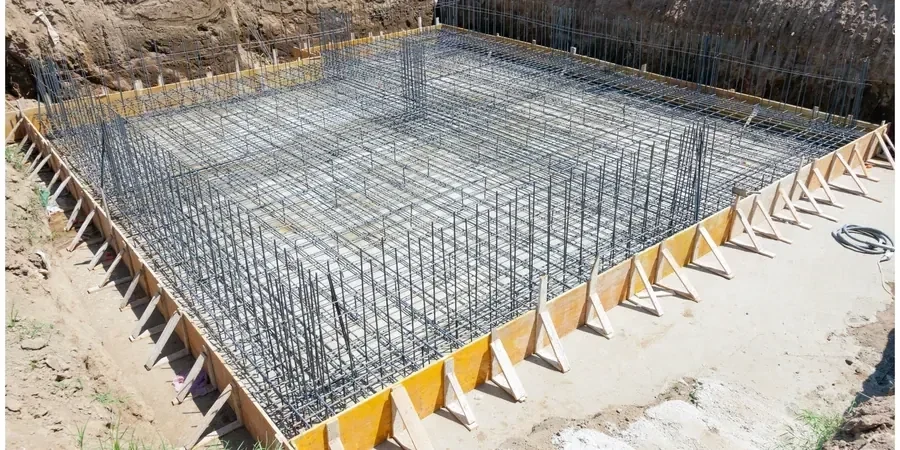
A common mistake we see in Knoxville is treating a mat foundation like a thickened slab-on-grade without accounting for the pinnacled rockhead. The Tennessee River Valley carved deep channels into the Ordovician limestone, leaving behind a landscape where competent rock can drop 30 feet over a 50-foot horizontal span. Ignoring this differential bearing capacity leads to angular distortion that cracks partition walls and binds elevator rails within the first two years. Our team approaches raft/mat foundation design as a soil-structure interaction problem first, modeling the variable compressibility of the residual clay overburden against the stiffness of the underlying Knox Group dolomite. The goal isn't just a bearing check; it's controlling total and differential settlement to under 12 mm across the footprint. The CPT test gives us a near-continuous profile of tip resistance through the clay crust and into the weathered rock, which is essential for calibrating the modulus of subgrade reaction across the irregular contact. In areas where the clay is thicker, we often supplement with SPT drilling to recover samples for Atterberg and consolidation testing, confirming the soil's preconsolidation pressure before running the finite element model.
In Knoxville's karst terrain, a properly designed mat foundation bridges the unpredictable rockhead, turning differential settlement risk into controlled, uniform support.
Local context
Knoxville's urban expansion south toward the French Broad River and west into the Bearden area has pushed development onto increasingly marginal ground. Historically, the city's core rests on relatively shallow limestone ridges, but the post-war suburbs occupy terrain with deeper saprolite profiles that can exceed 15 meters. The biggest geotechnical risk here isn't a sudden sinkhole collapse—though that's always a background concern in karst—but rather the progressive softening of the foundation clay from perched groundwater seeping through the decomposed rock. During the 2010–2015 apartment boom along Kingston Pike, we observed several projects where undersized mats suffered edge curling because the designers assumed uniform moisture conditions year-round. In reality, the seasonal wetting front in Knoxville's humid subtropical climate penetrates 3 to 4 meters, causing cyclic heave and shrinkage in the upper clay. A raft/mat foundation design must include a solid underslab drainage system with a capillary break, typically 150 mm of compacted #57 stone, to decouple the mat from these volume changes. Without it, the foundation behaves like a shallow bowl, trapping water and accelerating sulfate attack on the concrete.
Reference standards
IBC 2021 (International Building Code) – Section 1805: Foundation walls and footings, ASCE 7-22 – Minimum Design Loads for Buildings; Chapter 12 seismic provisions for Seismic Design Category C, ACI 318-19 – Building Code Requirements for Structural Concrete; mat foundation reinforcement and sulfate exposure classes, ASTM D1586 / D1586M-18 – Standard Test Method for SPT and Split-Barrel Sampling (rock refusal criteria in karst), FHWA-NHI-05-037 – Geotechnical Engineering Circular No. 5: Evaluation of Soil and Rock Properties (modulus of subgrade reaction estimation), ASTM D2435 / D2435M-11(2020) – One-Dimensional Consolidation Properties of Soils (for settlement analysis in residual clay)
Common questions
What is the typical cost range for a mat foundation design in the Knoxville area?
The engineering design fee for a raft/mat foundation on a commercial project in Knoxville typically ranges from US$930 to US$3,930, depending on the building footprint complexity, the number of load cases analyzed, and whether a 3D soil-structure interaction model is required. This covers the geotechnical design report, settlement analysis, and reinforcement recommendations, but excludes construction materials and special inspection costs.
When is a mat foundation preferred over isolated footings in East Tennessee?
A mat foundation becomes the better choice when the depth to bedrock varies by more than 5 feet across the footprint, when the allowable bearing pressure of the residual clay drops below 2,500 psf, or when the column spacing is tight enough that individual footings would overlap. In Knoxville's karst terrain, we also recommend mats for structures with sensitive finishes (hospitals, labs) where differential settlement tolerance is under 10 mm.
How do you handle the risk of sinkholes under a mat foundation?
Our approach uses a two-phase investigation. First, we run an electrical resistivity survey to identify low-resistivity anomalies that could indicate clay-filled cavities. Then we perform targeted CPT soundings and rock coring at those locations. If we find a void within the zone of influence (typically 1.5 times the mat width below the bearing level), we design the mat with reinforced, bridged zones capable of spanning a 6-foot diameter opening without structural failure, per the guidelines in Sowers (1996) for karst foundation engineering.
What seismic requirements apply to mat foundations in Knox County?
Knox County falls under Seismic Design Category C per ASCE 7-22, with a site coefficient Fv typically between 1.5 and 1.7 for Site Class D (stiff soil). The mat must be designed to resist the overturning and sliding forces from the seismic base shear. We analyze the foundation for the load combination 0.9D + 1.0E, checking that the resultant force stays within the middle third of the mat to avoid partial uplift. The connection between the mat and the vertical lateral-force-resisting system (shear walls or frames) is detailed for overstrength per ACI 318 Section 18.13.