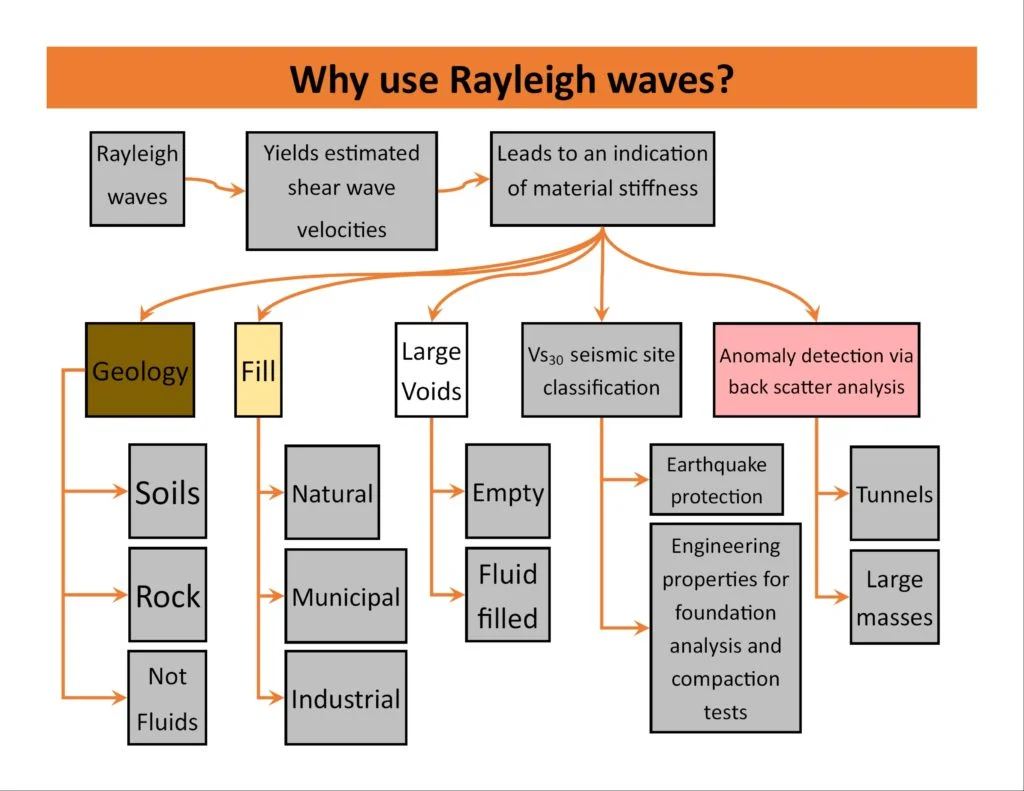
A five-story mixed-use building over on Gay Street stalled for weeks because the structural engineer flagged the site class assumption. The original geotech report assumed Site Class D based on SPT blow counts from residual clay, but the client needed a direct Vs30 measurement to satisfy the peer reviewer. That scenario plays out regularly in Knoxville, where the transition from ridge-top weathered limestone to valley-floor alluvium can shift your site class across a single lot. We run MASW surveys across the city—from the Holston River flats to the Fort Sanders neighborhood—to give engineers a defendable Vs30 profile that meets ASCE 7 Chapter 20 requirements without the cost of deep crosshole testing. For projects on fill over karst, we often pair the MASW profile with a seismic refraction line to map the top of competent rock, and for deep foundation design we integrate the shear wave data with SPT drilling to correlate stiffness with standard penetration resistance.
In Knox County karst, a Vs30 measurement can make the difference between Site Class C and D—and a 20% shift in your seismic base shear.
Local context
The sledgehammer strikes the plate and the geophone array records surface waves propagating across the weathered limestone residuum. If the top 5 meters are desiccated clay with high stiffness and the underlying saprolite is soft, the fundamental-mode dispersion curve can show a velocity inversion that fools an unconstrained inversion algorithm. We see this pattern in the Cedar Bluff area, where the Chickamauga limestone weathers unevenly. A blind inversion will overestimate Vs30 by 15 to 20 percent, pushing the site into a stiffer class than reality. Our processing workflow runs a multi-modal inversion and compares the fundamental-mode result against a higher-mode fit. If the two diverge, we flag the profile and discuss it with the structural engineer. For critical facilities, we recommend a paired CPT test to measure tip resistance and sleeve friction at the same location, giving a direct correlation between Vs and penetration resistance that anchors the inversion and eliminates the ambiguity.
Common questions
How much does a MASW survey cost for a single-family lot in Knoxville?
For a standard residential lot requiring one array line and a Vs30 report, the cost ranges from US$1.550 to US$3.290 depending on site access, array length needed to reach 30 m depth, and whether we need to clear brush or work around existing structures. Steep slopes in neighborhoods like Sequoyah Hills may require additional crew time.
Does MASW work in Knoxville karst limestone terrain?
Yes, but it requires careful interpretation. The stiff limestone bedrock at shallow depth creates a strong velocity contrast that can mask the fundamental Rayleigh wave mode. We use multi-modal inversion and, when needed, calibrate with a single SPT boring to confirm the depth to rock. The result is a reliable Vs30 even in areas underlain by the Knox Group carbonates.
What is the turnaround time for a Vs30 report?
Field work takes half a day for a single array. Data processing and inversion are completed the same day. The final signed report with the Vs profile, Vs30 calculation, and ASCE site class leaves our office within two business days. For rush projects, we can deliver in 24 hours if the field schedule permits.